Twenty-Four Frames of Hope: What We Lost When Photos Stopped Making Us Wait
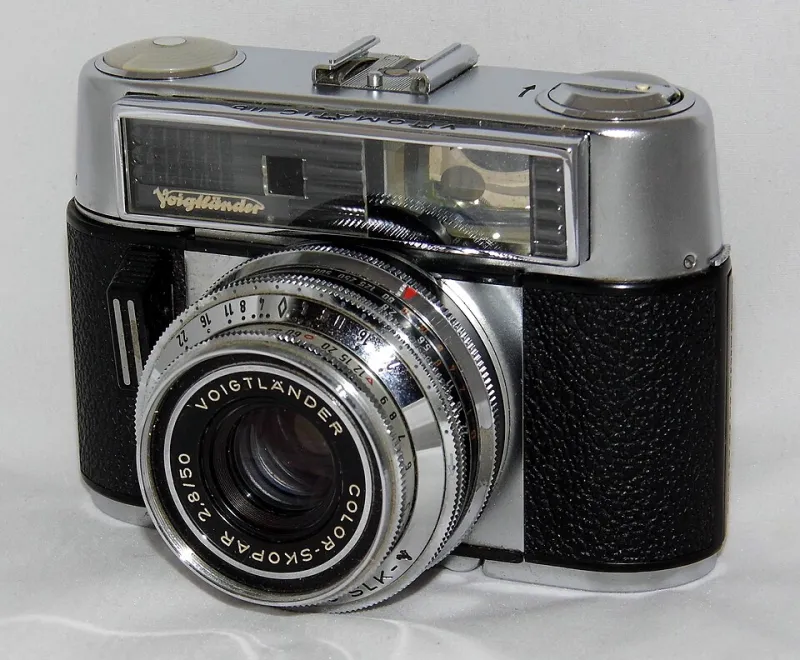
Photo: Joe Haupt from USA, CC BY-SA 2.0, via Wikimedia Commons
The yellow-and-black box was practically ceremonial. You'd buy a roll of Kodak film at the drugstore before a vacation — maybe two rolls if it was a big trip — tuck them into your bag with the care you'd give a passport, and spend the next two weeks making decisions. Is this moment worth a frame? Is the light good enough? Is everyone actually looking?
You had 24 shots, sometimes 36. Every press of the shutter cost something. And when you finally dropped the canister off at the photo counter on your way home, you handed over a little envelope of uncertainty and waited — sometimes a week, sometimes two — to find out what you'd actually captured.
For most of the second half of the twentieth century, that was photography. Not a limitation. Just the way it worked.
The Arithmetic of Scarcity
It's easy to frame the film era as a series of inconveniences now that a smartphone can take a thousand photos in an afternoon without costing a cent beyond the device itself. But scarcity does something to attention that abundance cannot replicate.
When you had 24 frames for a two-week vacation, you became, by necessity, a curator. You thought before you shot. You waited for the right moment rather than firing a burst and choosing later. You made a judgment — this is worth preserving — and committed to it with a click.
Family photographers developed an intuitive eye not because they were trained, but because they had to be. Wasting a frame on a blurry shot or a closed eye was a small but real loss. The discipline was built into the medium itself.
Professional photographers talk about this still. Many who trained on film describe it as a kind of education in seeing — in learning to read a scene before reaching for the camera rather than after. The constraint, paradoxically, produced clarity.
The Wait Was Part of It
But there's another dimension to the film experience that gets less attention: the wait itself.
Dropping off a roll of film and returning a week later to pick up an envelope of prints was a genuinely suspenseful ritual. You didn't know what you had until you had it. The vacation was over, the moment was gone, and only then did you find out whether you'd captured it at all.
Sometimes the results were disappointing — a thumb over the lens, a subject caught mid-blink, a beautiful landscape ruined by a smear of light from a poorly sealed camera back. But sometimes the opposite happened. A photo you'd half-forgotten taking came back from the lab as something unexpectedly perfect. A candid moment you'd barely registered — a child laughing at something off-camera, a grandparent caught in an unguarded smile — arrived in the envelope as a small revelation.
The delay created a kind of temporal distance between experience and memory that the instant image has almost entirely eliminated. You lived the moment, then you returned to it weeks later with fresh eyes. The photograph wasn't just a record; it was a reunion.
What Happened When the Wait Disappeared
Digital photography arrived gradually, then all at once. Consumer digital cameras appeared in the mid-1990s, improved rapidly through the early 2000s, and were effectively rendered obsolete as standalone devices when smartphone cameras became genuinely capable around 2010. The transition from scarce and delayed to limitless and instant took roughly fifteen years.
The changes in behavior were immediate and profound. People began photographing everything. Meals, commutes, idle moments, the backs of other people's heads at concerts. The average American now takes more photographs in a year than their grandparents took in a lifetime. The sheer volume is staggering — by some estimates, over a trillion photos are taken globally every year.
But something else changed alongside the volume, something subtler and harder to name. The relationship between taking a photograph and experiencing the moment it captures shifted in ways that researchers are still trying to understand.
Several studies have suggested that photographing an experience can actually impair memory of it — that the act of outsourcing documentation to a device reduces the brain's own investment in encoding the moment. When you know the photo exists, you don't work as hard to remember. Why would you?
There's also the question of attention. The film photographer, working with limited frames, was present in a particular way — scanning, assessing, deciding. The smartphone photographer, working with unlimited capacity, can be present or absent in equal measure. The camera is always available, which means the decision to put it away requires a deliberate act of will that it once required nothing at all.
The Albums We Never Make
Here's a telling symptom: most people's grandparents have physical photo albums. Careful, curated collections of prints, labeled in handwriting, organized by year or event. The photographs were selected — not every frame made the album — and the selection was itself a kind of storytelling.
Most people under forty have thousands of photographs stored across multiple devices and cloud services, organized by nothing more than the date and location their phone automatically assigned. They have more images than their grandparents could have imagined and, in many cases, a harder time finding the one they're looking for.
The abundance that was supposed to preserve everything has, for many people, made preservation feel unnecessary. Why curate when you can keep everything? Why print when the cloud never runs out of space?
The answer, of course, is that keeping everything is not the same as remembering anything.
The Frame That Meant Something
None of this is an argument for going back. Digital photography has democratized an art form, enabled documentation of events and communities that would otherwise have gone unrecorded, and made visual communication a universal language. The gains are real and large.
But the film era preserved something worth acknowledging: the idea that a photograph was a decision, not a reflex. That the act of pointing a camera at something was a statement — this matters, this is worth one of my twenty-four frames.
That little yellow box at the drugstore cost you something. And because it cost something, it meant something.
The best photographs from that era still feel different, somehow. Not technically — modern cameras are vastly superior. But in their weight. In the sense that someone stood there, looked carefully, and chose.