The Daily Knock That Nobody Noticed Was Saving Lives
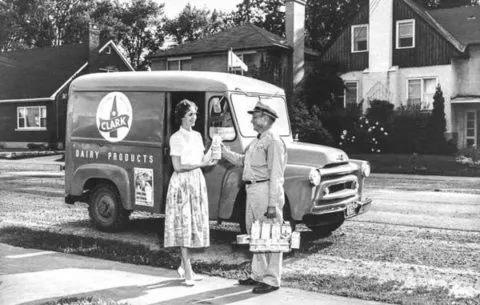
Photo: vintage American milkman doorstep delivery 1950s neighborhood morning, via www.gadgetreview.com
Nobody called it a wellness check. Nobody filled out a form or dispatched a case worker. There was no app, no hotline, no community outreach coordinator with a clipboard. There was just Roy, dropping off two quarts of whole milk and a pint of cream on the back step of the Hendersons' house — and noticing, on a Tuesday in November, that Monday's bottles were still sitting there, untouched.
That small observation — milk uncollected, curtains still drawn at nine in the morning — might have been the thing that sent someone to knock on the door. Which might have been the thing that saved a life.
For most of the twentieth century, this kind of informal safety net was woven invisibly into the fabric of American daily life. It didn't look like a social service. It looked like a milk route.
The Infrastructure of Regular Presence
To understand what's been lost, you first have to understand how much daily foot traffic moved through American residential neighborhoods at their peak. The milkman came before dawn. The mail carrier walked the same sidewalk every weekday around the same time. The bread deliveryman, the laundry route driver, the iceman before him — these were people whose jobs required them to appear, reliably, at your door or within sight of your home, day after day.
This regularity created something valuable that nobody designed on purpose: a distributed surveillance network run entirely on familiarity. Route workers knew their customers not as accounts in a ledger but as people with habits. Mrs. Calloway always took in her bottles before six. Old Mr. Ferretti left a note in the box if he was going to his daughter's for the week. When the pattern broke, it was noticeable — and in tight-knit communities, noticeable meant actionable.
Milkmen in particular accumulated a kind of intimate household knowledge that's hard to imagine in any modern service context. They knew who was sick, who had a new baby, who had recently lost a spouse. They adjusted orders without being asked. And they paid attention in ways that nobody asked them to pay attention — because when you visit the same thirty houses every morning for fifteen years, noticing becomes automatic.
The Cases That Made the Papers
The stories aren't hard to find in old newspaper archives. A mail carrier in Ohio who noticed three days of uncollected mail and called for a welfare check on an elderly widow, who turned out to have fallen. A milkman in Pennsylvania who found a note in the empty bottle from a customer describing a mental health crisis, and who drove that person to the hospital himself. A bread deliveryman in rural Georgia who was the first person to realize that a family of four hadn't been seen in almost a week.
These weren't outliers. They were the visible expressions of a system that worked quietly every day in ways that never made the news — the check-in that didn't result in a crisis, the brief conversation on the porch that gave an isolated elderly person their only human contact for the day, the deliveryman who simply asked "you doing alright?" and meant it.
Social workers and public health researchers who have studied this period sometimes describe these route workers as unintentional first responders — people whose jobs put them in a unique position to catch vulnerability early, before it became emergency.
The Slow Withdrawal
Home delivery didn't disappear overnight. The milkman faded gradually through the 1950s, 1960s, and 1970s as supermarkets expanded and refrigeration made weekly grocery runs more practical than daily deliveries. The bread route followed a similar arc. Mail carriers kept walking their routes — and still do — but the shift from letters to packages changed the nature of those interactions. You don't leave a note in a package slot the way you left one in a milk bottle.
What accelerated the withdrawal was something nobody quite intended: the optimization of delivery itself. As logistics became more efficient, routes got longer, stops got shorter, and the expectation of brief human interaction at the door gave way to the expectation of a package left on the porch without a knock. The contactless delivery — celebrated as a convenience, especially during the pandemic — completed a transformation that had been building for decades. The deliveryman's job became about throughput. Relationship was overhead.
What Automated Delivery Can't Do
Amazon delivers to more American homes in a single day than the entire milkman industry served in a month at its peak. The logistical achievement is staggering. But the Amazon driver who leaves a box at your door and photographs it for the app is optimized for speed, not for noticing. His route has eighty stops. He's not going to register that your neighbor's box from last Tuesday is still sitting there.
This isn't a criticism of the driver. It's a structural observation about what the system is built to do. Modern delivery is designed to move goods efficiently. The old system moved goods inefficiently — and in the slack of that inefficiency, human connection happened.
The absence of that connection has real costs that are difficult to quantify but easy to observe. Social isolation among elderly Americans has reached levels that public health officials describe as a crisis. The CDC has documented the health consequences of chronic loneliness — elevated cardiovascular risk, cognitive decline, increased mortality — with the same clinical seriousness once reserved for smoking. Community organizations and municipal governments are now spending money to create formal wellness check programs, hiring people specifically to do what the milkman used to do as a side effect of his actual job.
Building Back What Wasn't Built on Purpose
Some communities have tried to reconstruct pieces of the old informal network. Mail carriers in New Hampshire participate in a rural wellness program that flags customers who may need a welfare check. Certain senior-focused delivery services have trained their drivers to watch for signs of distress. A handful of cities have experimented with programs that pay delivery workers a small supplement to make brief check-in calls to elderly customers on their routes.
These are genuine efforts, and they matter. But there's something worth sitting with in the fact that we're now deliberately engineering what used to happen organically — spending public money to recreate a function that once emerged naturally from the simple act of showing up at someone's door every day with a bottle of milk.
The milkman wasn't a social worker. He was just a person with a route and enough time to notice. In a world optimized for speed and contactless convenience, that kind of noticing has become, quietly and without much fanfare, one of the things we miss most.