The Report Card That Knew Your Name: When a Teacher's Two Sentences Carried More Weight Than Any Test Score

The Report Card That Knew Your Name: When a Teacher's Two Sentences Carried More Weight Than Any Test Score
Picture a fourth-grade classroom in 1962. The school year is wrapping up, the windows are open, and somewhere down the hall a teacher — Miss Hargrove, let's say, twenty-two years in the same classroom — is sitting at her desk long after the kids have gone home. She's writing report cards. Not filling in bubbles. Not uploading scores to a portal. Writing. In cursive, in ink, about each of her thirty students as individuals.
Tommy shows real curiosity when the subject engages him, but struggles to channel that energy when it doesn't. He is kind to younger students and takes responsibility seriously. With encouragement and consistency, he will do well.
That was a report card. Not a data point. A portrait.
When Assessment Was a Human Act
For most of American educational history, the report card was exactly what the name implied — a report, from one person to another, about a child in full. Grades existed, sure, but they coexisted with written narratives that addressed character, effort, attitude, and what teachers used to call "citizenship." Whether you got along with others. Whether you kept trying when things got hard. Whether you were honest when it would have been easier not to be.
These weren't soft extras tacked onto the real evaluation. They were the evaluation, or at least half of it. A kid who got Bs but was described as persistent, curious, and kind was often considered a stronger prospect than an A student described as disengaged or unkind to peers. Parents read these comments carefully. They carried them to dinner table conversations. Some families kept them for decades.
The system was imperfect, obviously. A teacher's written assessment could reflect bias, favoritism, or simple exhaustion. There was no standardization, no consistency across schools or districts. What "good citizen" meant in one classroom might mean something entirely different three towns over.
But there was something those handwritten lines captured that no standardized metric has managed to replicate: the specific, irreducible fact of a particular child.
The Standardization Revolution
The move toward measurable outcomes didn't come from nowhere. By the mid-twentieth century, American schools were grappling with massive growth — baby boom enrollment, new suburbs, overwhelmed districts. Consistency became a genuine administrative need. How do you compare students across hundreds of schools in dozens of states without some shared measuring stick?
The answer, increasingly, was standardized testing. Iowa Tests of Basic Skills in the 1950s. The SAT's expanding influence through the 1960s and 70s. And then, with the 1983 report A Nation at Risk, a full cultural pivot toward accountability through measurement. Schools were failing, the argument went, and the proof was in the scores.
 Photo: Iowa Tests of Basic Skills, via i.ytimg.com
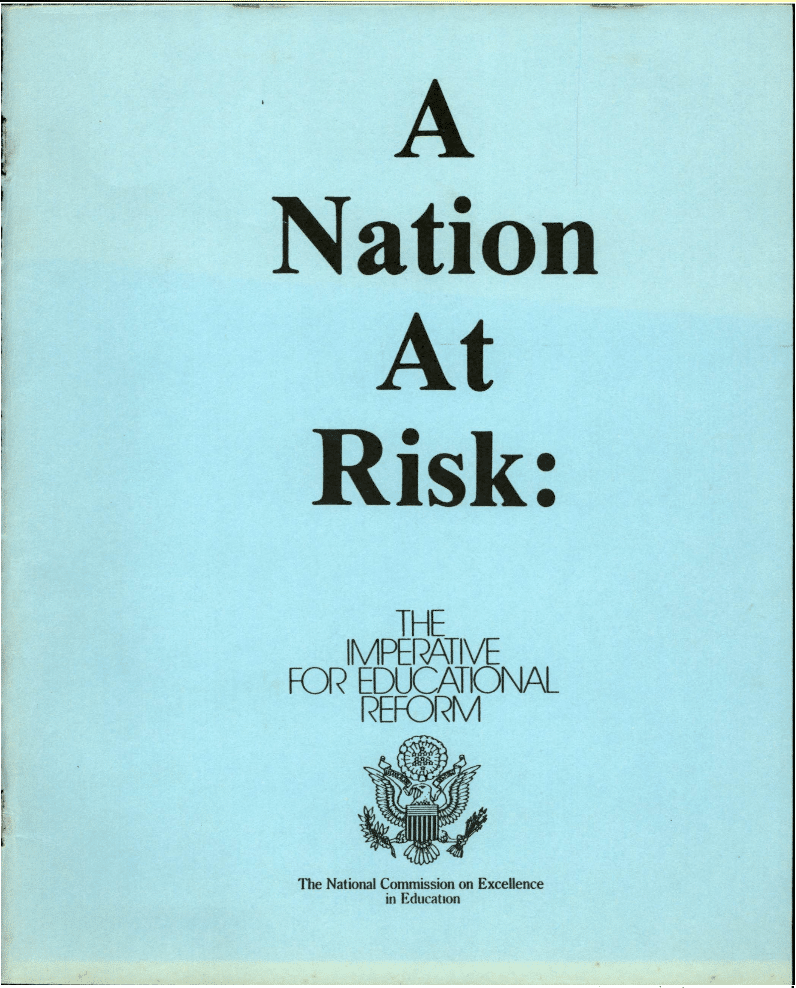 Photo: A Nation at Risk, via charterlibrary.org
No Child Left Behind in 2001 accelerated everything. Suddenly, schools were being graded on test performance, funding was tied to outcomes, and teachers found themselves spending more classroom time preparing students for assessments than actually teaching them. The written narrative on a report card — already fading — became almost an anachronism. There wasn't time. There wasn't a column for it in the database.
What Got Measured, and What Got Lost
Here's the uncomfortable truth about measuring education: the things that are easiest to measure are rarely the most important ones.
You can measure reading level at grade three. You can score a math test. You can rank students by GPA and sort them by percentile. What you cannot easily measure is intellectual courage — the willingness to ask a question that might sound dumb. You can't score empathy, or the ability to work through failure without shutting down, or the particular kind of creativity that shows up sideways, in the margins of a notebook, years before it becomes something real.
These qualities used to live in teacher narratives. They were noticed, named, and sent home to parents who might not have known to look for them. A kid who tested poorly but whose teacher wrote she approaches every problem from an angle I haven't seen before was being told something true and valuable about herself. Something that a percentile ranking could never say.
That kid, in today's system, might simply be a below-average score.
The College Admissions Machine
Nowhere has the data-over-character shift been more consequential than in college admissions. The modern process — SAT scores, class rank, GPA, AP course counts — is built almost entirely around quantifiable inputs. Personal essays exist, technically, but anyone who has worked in admissions knows they're often the last thing reviewed and the first thing cut when a decision is already clear from the numbers.
The result is a system that has become extraordinarily good at identifying students who are skilled at performing in structured academic environments, and considerably less good at identifying students who are genuinely interesting, resilient, creative, or kind. The kid who spent three years quietly mentoring younger students in her neighborhood, who reads voraciously but tests poorly due to anxiety, who would light up a college campus — that kid is often invisible to the algorithm.
Miss Hargrove would have seen her. She would have written it down.
A Pendulum Starting to Swing
There are real signs that American education is rethinking its relationship with pure measurement. The pandemic-driven shift to test-optional college admissions policies cracked open a long-overdue conversation. Portfolio-based assessments, competency frameworks, and social-emotional learning initiatives are growing in many districts. Some progressive private schools never fully abandoned narrative reporting.
The challenge is scale. Writing honest, individualized assessments for thirty students twice a year is genuinely hard work. It requires time, emotional investment, and a level of individual attention that overcrowded, underfunded schools struggle to provide. The standardized test isn't just a philosophical choice — it's also a logistical one.
But the question is worth sitting with. What did we decide to stop measuring when we decided that only the measurable things mattered? And what would it cost — in time, in resources, in institutional will — to start measuring those things again?
The Sentences That Stayed With You
Ask almost any adult over fifty about a teacher who made a difference, and what comes back isn't a grade. It's something someone said — in a conference, in a margin note, in a report card that a parent read out loud at the kitchen table. She sees things others miss. He has more to offer than he knows yet. This one is going to surprise people.
Those sentences didn't show up in any database. They didn't improve a school's standardized test ranking. But they changed how a kid understood themselves, sometimes for the rest of their life.
That's a return on investment no algorithm has ever calculated.