The Buick That Outlasted the Mortgage: When Americans Fixed Cars Instead of Ditching Them
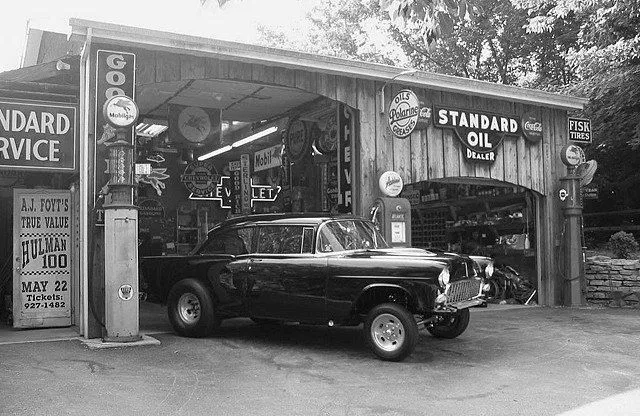
Photo: vintage 1960s mechanic repairing classic American car garage, via s-media-cache-ak0.pinimg.com
Somewhere in a garage in suburban Ohio in 1974, a man named Gerald is lying on a creeper under a 1961 Buick LeSabre. He's been under there for the better part of a Saturday afternoon. His son is handing him tools through the gap between the floor and the rocker panel. The car has 140,000 miles on it. Gerald has no intention of getting rid of it. He's replacing the brake cylinders, and when that's done, he'll check the points and maybe adjust the carburetor.
The Buick will still be in the family in 1981.
That relationship — between an American, a wrench, and a machine worth keeping — is something that has faded so quietly over the past forty years that most people under thirty can barely imagine it. We now live in a world where a car with 100,000 miles is considered old and a six-year-old vehicle is practically disposable. How did we get here, and what did we lose on the way?
When the Driveway Was the Workshop
For the postwar generation of American drivers, mechanical self-sufficiency wasn't a hobby — it was an economic necessity and a point of pride. Cars of the 1950s, 1960s, and much of the 1970s were mechanically accessible in a way that today's vehicles simply aren't. The engines were large, uncluttered, and designed with the assumption that someone might need to work on them without specialized equipment.
You could change your own oil in twenty minutes with a socket set and a drain pan. Spark plugs were visible and reachable. Brake pads were straightforward to replace. Carburetors could be rebuilt with a kit from the auto parts store and an afternoon of patience. A basic competency with these systems wasn't unusual — it was expected of most adult men and plenty of women who had grown up watching their fathers do the same.
The local mechanic existed for the bigger jobs, but even there the relationship was different. Mechanics in small towns knew their customers' vehicles intimately. They tracked repair histories, advised on what to fix next, and gave honest assessments of whether a car was worth saving. The goal was almost always to save it.
The Economics of Keeping vs. Replacing
This repair culture was driven by straightforward economics. A new car in 1965 cost roughly $2,500 — the equivalent of many months of an average worker's salary. Buying a new one wasn't a casual decision. You bought a car, and then you took care of it, because the alternative was a significant financial commitment your household might not be ready to make.
This created a virtuous cycle of maintenance. Cars that were regularly serviced lasted longer. Cars that lasted longer justified further investment in repairs. A vehicle with 150,000 miles that ran well was a genuine asset — proof that someone had been paying attention.
The rise of affordable financing in the 1980s and 1990s began to erode that logic. Suddenly, the monthly payment on a new car wasn't dramatically different from what you might spend keeping an older one running — at least on paper. Dealers got very good at framing the trade-in as the sensible choice. Why put $800 into a car that's worth $1,200, they'd ask, when you could put that same money toward a down payment on something new?
It was a seductive argument, and it worked.
The Computer Under the Hood
Manufacturing changes accelerated the shift in ways that had nothing to do with consumer psychology. Beginning in the late 1980s and surging through the 1990s, automobiles became increasingly computerized. Engine management systems, electronic fuel injection, and an expanding network of sensors transformed what had been a mechanical puzzle into something more like a networked device.
This wasn't inherently bad — modern vehicles are dramatically more fuel-efficient, safer, and reliable than their predecessors. A well-maintained 2020 sedan will likely run more smoothly at 80,000 miles than a 1970 sedan did at 40,000. The engineering progress is real and significant.
But computerization also moved repair work out of the driveway and into the dealership. When your check engine light comes on, you need a diagnostic scanner that costs thousands of dollars to interpret the error codes. When the transmission control module fails, you're not rebuilding it in your garage on a Saturday — you're having it replaced at a shop that charges $120 an hour. The accessibility that made home repair practical has largely vanished beneath layers of software and proprietary systems.
Modern warranty structures reinforced this. Automakers began offering longer factory warranties partly as a competitive tool, but the effect was to shift the maintenance relationship from the owner to the dealer network. For the first several years of a vehicle's life, you were almost discouraged from developing your own mechanical familiarity with it.
The Replacement Mindset and What It Reveals
We now live in what economists sometimes call a throwaway economy — a world where the cost of replacement has fallen relative to the cost of repair across almost every consumer category. This is partly a triumph of manufacturing efficiency and global supply chains. It's also a quiet cultural shift in how we relate to the things we own.
The old relationship with a car — intimate, long-term, characterized by ongoing investment and attention — implied a different understanding of ownership. You weren't just a user of the vehicle; you were its custodian. You knew its quirks, its history, its particular mechanical personality. Gerald under the LeSabre on that Ohio Saturday wasn't just fixing brakes. He was maintaining a relationship.
The modern car-buying cycle, where many Americans trade in their vehicles every three to five years and rarely engage with what's under the hood at all, produces a fundamentally different experience of ownership. Convenient, certainly. Clean and predictable. But also strangely detached.
The Garage That Went Quiet
Drive through almost any suburban neighborhood today and you'll find garages full of storage, gym equipment, and holiday decorations. The car sits in the driveway. The tools, if they exist at all, are gathering dust.
That's not entirely a loss — plenty of people are glad not to spend their Saturdays covered in grease. But something genuine has faded: the satisfaction of understanding the machine that carries you, of keeping something alive through your own effort and attention, of watching a vehicle accumulate years and miles because you refused to give up on it.
The Buick that outlasted the mortgage wasn't just transportation. It was a statement about patience, competence, and the stubborn conviction that things worth having are worth taking care of.
We don't make that statement much anymore.