When Doctors Performed for an Audience: The Strange History of Medicine as Public Spectacle
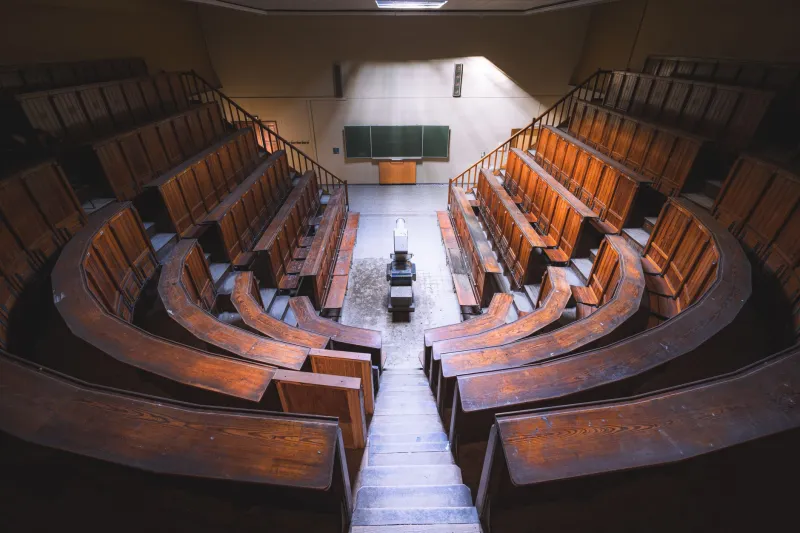
Somewhere in the older buildings of America's most prestigious medical schools, you can still find them: tiered, circular rooms with steep wooden galleries rising above a central floor. The lighting was designed to illuminate a single point. The seating angled inward. They look, unmistakably, like theaters — because that's exactly what they were.
The surgical amphitheater is one of the most quietly extraordinary artifacts of American medical history. For well over a century, the operating table was, in a very real sense, a stage.
The Gallery Was Always Full
From the early 1800s through the first decades of the twentieth century, surgery in the United States was a semi-public event. Medical students were the primary audience, certainly — but the gallery wasn't always limited to them. At major teaching hospitals, operations were understood to be educational occasions, and education implied an audience.
Surgeons lectured as they worked. They narrated incisions, explained anatomy in real time, and fielded questions from the rows of observers above. The best surgical teachers were known for their ability to perform under scrutiny — not just technically, but rhetorically. A great surgeon was also, by definition, a great explainer.
The Massachusetts General Hospital's Ether Dome, where the first public demonstration of anesthetic ether took place in 1846, seated dozens of observers. The moment was so significant that artists painted it. The audience was the point. Witnessing was how medicine validated itself.
What Changed, and Why
The transition away from open surgical observation wasn't a single decision — it was a slow accumulation of shifts, each reasonable on its own, that collectively transformed medicine into one of the most private professional spaces in American life.
Germ theory changed the calculus first. As the medical community absorbed Louis Pasteur's and Joseph Lister's work on infection and antisepsis in the latter half of the 1800s, the presence of multiple bodies in an operating space started to look less like education and more like contamination risk. The gallery didn't disappear overnight, but its population thinned. Observers were pushed further back. Then further still.
The twentieth century added new layers. Patient rights movements, gathering force through the 1960s and 70s, established informed consent as a cornerstone of medical ethics — which meant that patients had meaningful say over who witnessed their procedures. HIPAA, arriving in 1996, formalized privacy protections that had been building culturally for decades. By the time most Americans alive today were born, the idea of watching surgery as a spectator was not just unusual. It was essentially inconceivable.
What Medical Education Lost in the Trade
Here's where it gets interesting. The shift toward privacy was, in most respects, genuinely good for patients. Dignity matters. Informed consent matters. The old surgical theater, for all its educational value, operated on an implicit assumption that the patient's body was a teaching resource first and a person second. That assumption deserved to be challenged.
But something real was lost in the transition — and medical educators have spent decades trying to replace it.
The amphitheater model produced a particular kind of physician. One who was comfortable being observed, questioned, and critiqued in real time. One who could explain their reasoning while executing it. The closed operating room, by contrast, is a more private space — and private spaces, however necessary, don't always generate the same pressure toward transparency.
Modern medical education has compensated with simulation labs, recorded procedures, and increasingly sophisticated virtual reality training. These tools are remarkable. They are also, by nature, controlled environments — which is a different thing than performing under the gaze of a gallery full of skeptical peers.
The Transparency Paradox
There's a strange irony threading through this history. Americans in 2024 have access to more medical information than any previous generation. We can watch surgical procedures on YouTube. We can read clinical trial data. We can consult online communities of patients who share detailed accounts of their own treatment. Medical knowledge has never been more democratized.
And yet the actual practice of medicine — the room where the decisions get made — has never been more closed. We know more about surgery in the abstract than any nineteenth-century observer in a gallery ever did. We know almost nothing about what happens in the specific room where our specific doctor makes specific choices about our specific body.
The surgical amphitheater represented a particular theory of institutional trust: that expertise demonstrated publicly is expertise that earns its authority. The closed operating room represents a different theory: that privacy protects dignity, and that trust should be extended to credentialed professionals without requiring performance.
Both theories have something to recommend them. The tension between them hasn't been resolved — it's just been quietly rearranged.
The Room We Can't Enter
Next time you're in a hospital — waiting for news about someone you love, or preparing for something yourself — think about what it would mean to watch. Not from morbid curiosity, but from the old instinct that seeing is understanding, that witnessing builds trust, that expertise and transparency are natural partners.
We gave that up for good reasons. But we gave it up. And the shape of that absence tells us something about how far medicine has traveled — and how much of the journey happened without anyone really deciding to make the trip.