The Big Yellow Book That Knew Everybody: Life Before the Internet Had a Directory
Photo: May Rivers, Public domain, via Wikimedia Commons
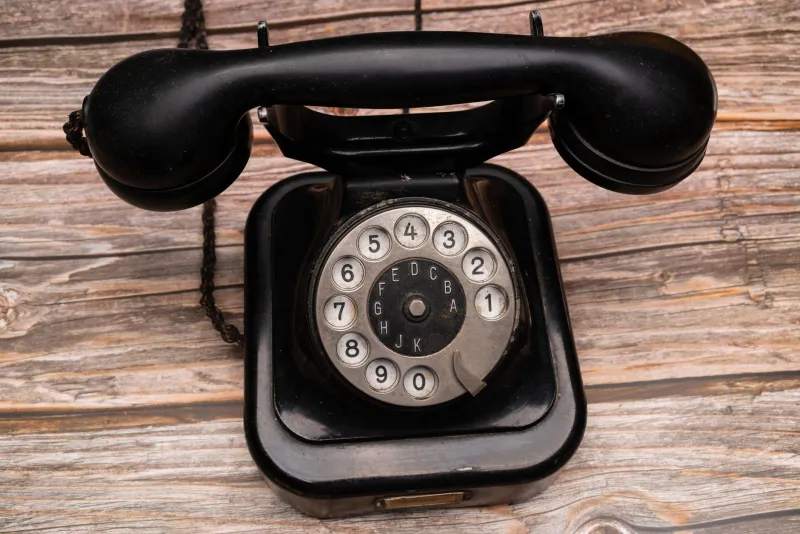
Once a year, usually without warning, it would appear on your front porch or tucked against your apartment door — thick, slightly waxy-smelling, and heavier than it had any right to be. The phone book. You'd haul it inside, maybe flip through it out of curiosity, and then slide it into a kitchen drawer or prop it under the landline where it would live, reliably, for the next twelve months.
For most of the twentieth century, the telephone directory was something close to a complete social map of your community. Every household that had a phone — and eventually that was almost all of them — appeared somewhere in those pages. Your neighbor across the street. Your kid's piano teacher. The dry cleaner on Fifth. All of them, alphabetically organized, waiting for you to find them.
It sounds almost quaint now. It was, in practice, something more interesting than that.
A Census That Arrived Annually
The phone directory was, in a genuine sense, a yearly census of local life. When a new family moved to town, they appeared in next year's book. When someone died, their listing quietly disappeared. Businesses that had closed weren't there anymore. New ones were. The book wasn't just a reference tool — it was a document of community change, delivered to every household simultaneously.
This shared document created something we've largely lost: a common information baseline. If you wanted to find a plumber in 1975, you opened the Yellow Pages and saw the same options your neighbor saw, the same options your employer saw, the same options everyone in your ZIP code was working from. The playing field, informationally speaking, was flat. Nobody had a better search algorithm than anyone else. You had the same book.
 Photo: Yellow Pages, via www.davidairey.com
Small businesses understood this intimately. A bold-print listing in the Yellow Pages — slightly larger than the standard entry, maybe with a box around it — was a genuine competitive advantage. Entire advertising strategies were built around alphabetical positioning. Why do you think so many businesses in that era were named things like "AAA Plumbing" or "Ace Electric"? Getting to the top of the A's wasn't an accident. It was a marketing decision.
The White Pages Were Personal
If the Yellow Pages were the commercial layer of the directory, the White Pages were something more intimate. They were where ordinary people lived — listed by last name, first name, address, and number. Looking someone up in the White Pages felt different from a Google search. It was slower, more deliberate, and strangely more human.
You'd run your finger down the column until you found the name. And in the process, you'd pass dozens of other names — some familiar, some strangers, all of them real people in your real town. There was a texture to that experience that a search bar doesn't replicate. You weren't retrieving a data point. You were navigating a community.
Privacy worked differently too. Being unlisted was a specific, conscious choice — you had to actively opt out. The default assumption was that if you had a phone, your number was public knowledge, available to anyone who cared to look. That norm seems almost shocking now, in an era when sharing your address feels like a security risk. But in the context of a community where everyone largely knew everyone, it made a certain kind of sense.
The Trust Layer Built Into Paper
Here's something that gets overlooked in the nostalgia for phone books: they came with a built-in trust layer that modern digital search doesn't have. If a business appeared in the directory, it had a listed address and a working phone number. It was, at minimum, a real entity that the phone company had verified enough to print.
Today, finding a local service provider means navigating a landscape of Google reviews that may or may not be genuine, Yelp ratings that businesses can game, and sponsored results that prioritize payment over quality. The phone book didn't have fake reviews. It didn't have sponsored placement in the White Pages. Your neighbor's listing appeared because your neighbor had a phone — full stop.
That simplicity made the directory surprisingly trustworthy in ways that our current information environment struggles to match. When you called the number in the book, you had reasonable confidence that the business existed, was local, and had been there long enough to make the print deadline. That was a low bar, but it was a consistent one.
When the Book Stopped Coming
The decline of the phone book happened gradually and then all at once. By the mid-2000s, directories were thinner, delivered less reliably, and increasingly treated as junk mail by the households that received them. Internet search had made the reference function obsolete. Recycling bins across America filled with unopened Yellow Pages still in their plastic wrap.
The last major residential directories were published in the early 2010s in most markets. Some specialized directories lingered longer. But the era of the annual community document — that thick, shared, alphabetically organized snapshot of local life — was essentially over within a decade of the internet going mainstream.
What replaced it was more powerful and infinitely more fragmented. Google can find you a 24-hour plumber at 2 a.m. in a way that no phone book ever could. Yelp can surface reviews from hundreds of customers. Online maps can route you there. The functional capabilities of modern search dwarf anything the directory ever offered.
Something Got Lost in the Translation
And yet. The phone book gave you something that an algorithm fundamentally cannot: a sense of the whole. When you opened the directory, you weren't seeing a curated, personalized, behaviorally targeted slice of your community. You were seeing all of it — every business, every household, every name that had a phone and a local address. The information was dumb. It was also complete.
There's a particular kind of disorientation in modern local search — the feeling that you're never quite sure what you're not seeing. The phone book, for all its limitations, never had that problem. What was in it was in it. What wasn't, wasn't. The boundaries were clear.
That clarity — that sense of a shared, navigable community map — is one of the quieter things the digital age replaced without fully replicating. We can find more now. We just can't always tell whether we're finding everything.