Number Please: When Every Call in America Went Through Mildred at the Switchboard
Pick up your smartphone today and you can instantly reach anyone, anywhere in the world. But for the first half of the 20th century, making a phone call in America meant having a conversation with someone whose job was to know everything about everyone in town. The local telephone operator wasn't just a voice on the line—she was the human internet of her community.
The Voice Everyone Recognized
In 1950s Millerville, Ohio, when you picked up your telephone, you didn't hear a dial tone. You heard Mildred Peterson's voice saying "Number please." Mildred knew that Dr. Williams always called the pharmacy at 3 PM to check on prescriptions. She knew that Mrs. Henderson called her sister in Toledo every Sunday after church. She knew that when teenage couples whispered into the phone late at night, their parents probably didn't know about it.
 Photo: Millerville, Ohio, via www.centreadrienroche.com
 Photo: Mildred Peterson, via wl-sympa.cf.tsp.li
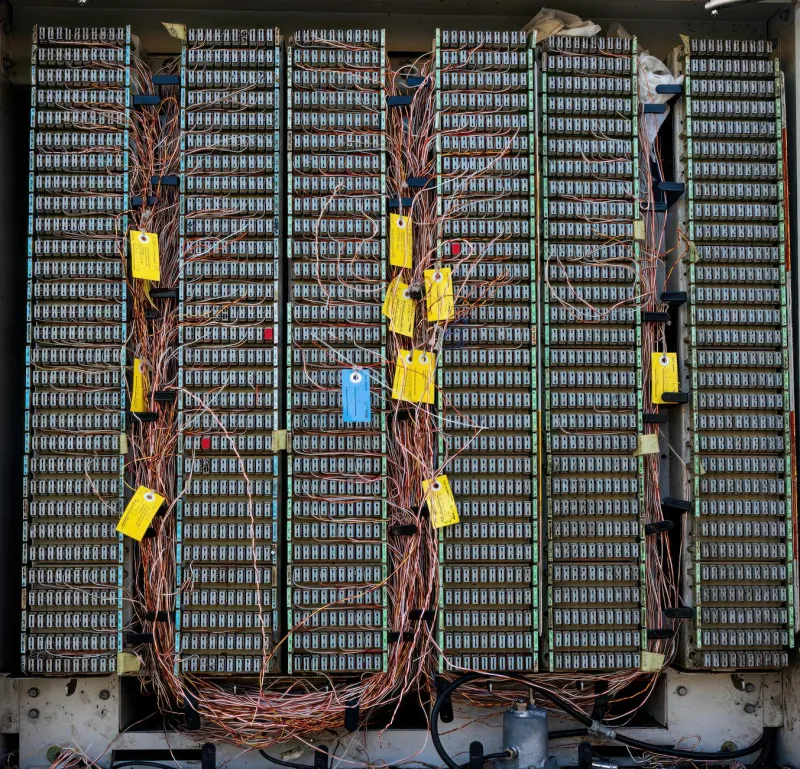
Mildred and her fellow operators—almost always women—sat at massive switchboards lined with holes, plugs, and blinking lights. Each incoming call lit up a bulb, and the operator would plug in her headset to ask where the caller wanted to be connected. She'd then physically insert another plug to complete the circuit, literally connecting one person to another through her hands.
The Information Hub
But operators did far more than connect calls. They were the town's unofficial information clearinghouse. Need to know if the hardware store was open on Saturday? The operator knew. Wondering if Dr. Johnson was making house calls during the snowstorm? She'd already fielded six similar calls and could tell you he was out on Elm Street.
Operators took messages when people weren't home—long before answering machines existed. They'd write down detailed notes and call back later to relay information. If someone's house caught fire, the operator often knew about it before the fire department, having overheard frantic calls and immediately connected families to emergency services.
During medical emergencies, operators became literal lifelines. They'd stay on the line during difficult births, connecting doctors with families and coordinating care. In rural areas where the nearest hospital was hours away, the operator might be the crucial link between a patient and life-saving medical advice.
Party Lines and Shared Secrets
Most Americans today have never experienced a party line—a single telephone line shared by multiple households. Each family had a distinctive ring pattern: one long ring for the Johnsons, two short rings for the Millers, three long rings for the Petersons. But anyone on the line could listen in to anyone else's conversation.
This wasn't considered eavesdropping—it was community participation. Neighbors learned about illnesses, celebrations, and local news by casually listening in on calls. The operator, hearing everything, became the keeper of the town's collective memory and secrets.
Some operators took their discretion seriously, never gossiping about what they heard. Others became the unofficial town criers, carefully sharing appropriate information while protecting genuine secrets. The best operators knew exactly what should be shared and what should stay private.
Technology Meets Humanity
The contrast with today's communication is stark. Modern smartphones connect us to billions of people instantly, but those connections are increasingly impersonal. We text instead of calling, email instead of visiting, and often communicate more with distant strangers than with neighbors.
When you called someone in the operator era, you first had to talk to a real person who lived in your community. This brief human interaction—even if just "Number please" and "Thank you"—created a sense of connection that today's direct dialing eliminated.
Operators also provided a safety net that modern technology struggles to replicate. If you were having a medical emergency and couldn't speak clearly, the operator might recognize your voice and immediately understand the situation. If you were confused or scared, she could stay on the line and provide reassurance while getting help.
The Beginning of the End
Direct dialing technology existed as early as the 1920s, but most communities didn't adopt it until the 1950s and 1960s. The transition wasn't just about technology—it was about economics. Operators were expensive, and phone companies could save millions by automating the connection process.
The first fully automated exchanges appeared in major cities, but small towns held onto their operators longer. Rural communities, in particular, resisted the change because their operators provided services that technology couldn't replicate: local knowledge, emergency coordination, and human connection.
By 1960, most American phone calls were directly dialed, though some small towns kept operators into the 1980s. The last manual switchboard in the United States didn't close until 1983, in Bryant Pond, Maine—a town that refused to give up the personal touch until the very end.
 Photo: Bryant Pond, Maine, via os-sesvetska-sela-zg.skole.hr
What We Gained and Lost
Modern telecommunications offer incredible advantages. We can call anywhere in the world instantly, often for free. We can send text messages, photos, and videos. We can video chat with people on the other side of the planet as easily as calling next door.
But we lost something irreplaceable when operators disappeared: a human filter that made communication more thoughtful and connected us to our immediate communities. The operator era forced every phone call to begin with a human interaction, however brief.
Today's communication technology is faster, cheaper, and more convenient—but it's also more isolating. We can reach anyone, anywhere, but we're less likely to know our neighbors. We have more ways to communicate but often feel less connected to the people around us.
The Last Operators
A few manual switchboards still operate today, mostly in remote areas of Alaska where modern infrastructure hasn't reached. The operators who work these systems report that the job hasn't changed much—they still connect calls, take messages, and serve as community information hubs.
These last operators offer a glimpse into what we lost when we automated human connection out of our communication systems. They know their communities intimately, provide personalized service that no app can match, and create the kind of human bonds that once made telephone service about more than just connecting calls.
Remembering Mildred
The next time you tap a name on your phone and instantly connect to someone thousands of miles away, remember Mildred Peterson at her switchboard in Millerville, Ohio. She couldn't connect you to the world, but she connected you to your community in ways that no technology has managed to replicate.
In our rush toward instant global communication, we may have lost something essential about what it means to be connected—not just to information, but to the people and places that make up the fabric of daily life.