Your Name in the Book: The Hotel Register That Remembered Everything About You
There is something quietly revealing about the objects a culture chooses to preserve. In the back offices and archives of America's oldest hotels — the grand downtown properties that survived the twentieth century largely intact — you can sometimes find them: thick, cloth-bound ledgers, their pages dense with handwritten names, dates, and notations. Room 214. Mr. Harold Whitfield, Chicago. Prefers quiet floor. No feather pillows. Traveling alone.
Somebody wrote that down. Somebody remembered it next time.
The Ledger as Living Document
The hotel register was, for most of American hospitality history, the operational backbone of a property. Every guest who walked through the door signed in — full name, home address, sometimes occupation. It was a legal requirement in most states, a holdover from the era when hotels served as de facto public records of who was where and when.
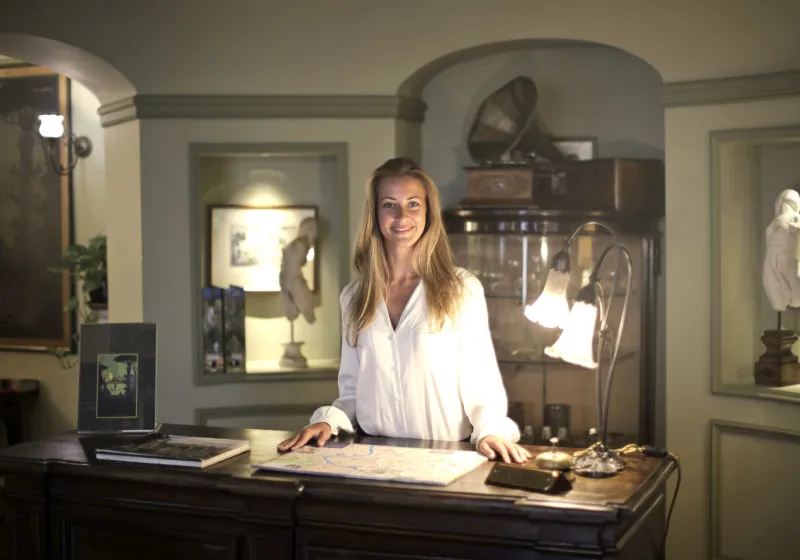
But beyond the legal function, the register served something more personal. In an era before computerized property management systems, the front desk staff's institutional memory was the guest profile. A good desk clerk at a well-run hotel knew the regulars by name before they reached the counter. They knew Mr. Whitfield from Chicago always wanted the fourth floor, always tipped well, always asked about a restaurant two blocks over that had closed in 1951 and somehow never registered the fact.
This was not data. It was human attention — which is a different thing entirely.
Small-town hotels and motor courts operated on an even more intimate scale. The family that ran the motel outside of Flagstaff, Arizona, or the boarding house near the train depot in rural Georgia, kept knowledge that no corporate system could have captured. They knew which traveling salesmen were reliable and which weren't. They knew who was passing through quietly and who wanted to be seen. They knew things that guests had never explicitly told them, because paying attention was part of the job.
The Pivot to Plastic and Pixels
The shift began gradually in the 1960s and accelerated sharply through the 1980s and 90s. Credit cards replaced cash as the primary payment method, which meant a name and a card number could stand in for a signature and an address. Computerized reservation systems arrived, allowing chains to manage bookings across dozens of properties from a central database. The handwritten ledger started looking like charming inefficiency.
By the early 2000s, the check-in experience at most American hotels had been standardized into something close to what it is today: a driver's license, a credit card, a room key that's actually a piece of plastic with a magnetic stripe, and a transaction that takes approximately ninety seconds if nothing goes wrong.
The front desk clerk stopped needing to remember you. The system was supposed to do it instead.
Loyalty Programs and the Algorithm That Pretends to Know You
Here's the part that would have genuinely baffled a 1955 hotel manager: we traded intimate human knowledge for algorithmic profiles, and then the algorithms sold our data to people we've never met.
Modern hotel loyalty programs are extraordinary pieces of engineering. They track your stay history, your room preferences, your food and beverage spending, your check-in and check-out times. A top-tier member at a major American hotel chain has a profile that contains more factual data points than any ledger clerk could have memorized. The system knows you've stayed 47 nights this year, that you always request a high floor, that you use the gym before 7 a.m.
And yet — ask anyone who travels frequently — something in the experience feels thinner. The recognition, when it comes, feels performed rather than genuine. The upgrade feels like a calculation rather than a gesture. The front desk agent reading from a screen is doing something categorically different from the desk clerk who remembered your name because they'd met you three times and paid attention each time.
The difference is not just sentimental. Human memory, applied to a specific person, generates a kind of warmth that data retrieval doesn't replicate. When someone remembers you, it means they noticed you. When an algorithm surfaces your profile, it means you were logged.
The Privacy Bargain Nobody Fully Read
The old hotel register had its own privacy problems, of course. The ledger was visible to anyone behind the desk. It was accessible to law enforcement without much procedural friction. In the era before privacy rights had been clearly articulated, a guest's presence at a hotel — and who they were with — was considered semi-public information in ways that would be legally untenable today.
The digital transition was supposed to fix this. Encrypted databases. Secure card processing. Loyalty program data protected by terms of service and corporate privacy policies.
What actually happened is more complicated. The old ledger clerk in Flagstaff knew your pillow preference and forgot it when you died. The loyalty database knows your pillow preference and has shared it with seventeen marketing partners whose names you've never heard. The handwritten register was visible to a handful of people in a single building. Your digital guest profile is, in various forms, visible to entities you cannot identify, for purposes you did not consent to in any meaningful sense.
We traded intimate service for convenient anonymity. Then we discovered the anonymity wasn't real — it had just moved somewhere we couldn't see.
The Book Is Closed
The hotel register as a physical object is essentially gone from American hospitality. A few boutique properties keep them for atmosphere — a leather-bound book on a mahogany counter, more prop than record. The real register is a server somewhere, and it knows far more about you than Mr. Whitfield's four lines of handwritten notation ever did.
Whether that's progress depends on what you think hospitality is actually for. If it's a transaction, the algorithm is more efficient. If it's a relationship, something got lost in the migration — and the ledger, for all its limitations, at least had the honesty to sit on the counter where you could see it.