When Walking Across the Stage Meant Walking Into the Middle Class
The High School Graduate Who Built America
In 1970, Tom Rodriguez walked across his graduation stage in Akron, Ohio, picked up his diploma, and two weeks later started his first day at Goodyear Tire. No college applications, no student loans, no career counseling sessions about "finding his passion." Just a handshake, a starting wage that could support a family, and a clear path to the American Dream.
Tom wasn't unusual. Across America, high school graduates were walking straight into stable, middle-class careers. Manufacturing plants, utility companies, banks, and government offices actively recruited from local high schools, offering training programs, pension plans, and wages that could buy a house and raise kids. The bachelor's degree was something for doctors, lawyers, and teachers — not for the millions of Americans who kept the country running.
Today, that same Goodyear job requires a bachelor's degree.
The Great Credential Shift
Somewhere between Tom's graduation and today, America quietly moved the goalposts. Jobs that once welcomed high school graduates with open arms began requiring college degrees. Not because the work became more complex, not because new skills were needed, but because employers could demand them.
This wasn't a sudden policy change or a dramatic economic shift. It was a gradual creep that happened one job posting at a time, one HR department at a time. Administrative assistant positions that once required a high school diploma started asking for "college preferred." Then "college required." Manufacturing jobs that had trained workers on-site began demanding technical degrees. Even retail management positions started requiring four-year degrees for tasks that hadn't fundamentally changed in decades.
The numbers tell the story starkly. In 1973, just 28% of American adults had any college education. Today, that figure has more than doubled. But here's the crucial detail: many of the jobs requiring degrees today are essentially the same jobs that didn't require them fifty years ago.
When Training Was the Employer's Job
The old system worked differently. Companies expected to invest in their workers. Ford Motor Company didn't hire mechanics — they hired mechanically inclined high school graduates and taught them to be Ford mechanics. AT&T didn't recruit telecommunications experts — they found smart, reliable people and trained them in telephone systems.
This approach made economic sense when companies expected employees to stay for decades. Why demand expensive pre-training when you could provide specific, relevant training and build loyalty simultaneously? The apprenticeship model thrived across industries, from skilled trades to white-collar work.
Major corporations operated extensive training programs. IBM's education programs were so comprehensive they were sometimes called "IBM University." General Electric rotated promising high school graduates through different departments, teaching them everything from accounting to engineering. These weren't charity programs — they were strategic investments in human capital.
The social contract was clear: companies would provide training and career development in exchange for loyalty and long-term commitment. High school graduates could envision a future where hard work and company training would lead to promotions, raises, and eventually comfortable retirements.
The Economics Behind the Change
Several forces converged to break this system. Globalization and technological change made companies less willing to invest heavily in worker training when jobs might disappear or move overseas. The rise of 401(k) plans over pensions reduced long-term commitments between employers and workers. Labor unions, which had negotiated many training programs, declined in membership and influence.
But perhaps most importantly, the supply of college graduates increased dramatically. As more Americans attended college — encouraged by federal financial aid programs and cultural messaging about higher education — employers found they could demand degrees simply because they could. Why settle for a high school graduate when college graduates were available for the same position?
This created what economists call "credential inflation" — requiring higher qualifications not because jobs became more complex, but because higher qualifications became available. A college degree became a sorting mechanism, a way for employers to narrow candidate pools without having to evaluate individual capabilities.
The Hidden Costs of Credential Creep
The shift didn't happen in isolation. As employers began requiring degrees for middle-class jobs, American families got the message: college wasn't just helpful for getting ahead anymore — it was necessary for not falling behind.
This transformed higher education from an opportunity into an obligation. Parents who had built middle-class lives with high school diplomas found themselves taking second mortgages to send their kids to college for jobs that weren't fundamentally different from the ones they'd gotten decades earlier.
The financial burden was enormous. Student loan debt, virtually unknown in previous generations, became a standard part of young adult life. The cost of entry to the middle class had quietly inflated from zero to tens of thousands of dollars.
Meanwhile, capable workers were shut out of opportunities not because they lacked skills, but because they lacked credentials. High school graduates who might have thrived in earlier eras found themselves competing for lower-wage service jobs, while positions that matched their abilities remained artificially out of reach.
Skills Versus Signals
Research consistently shows that many jobs requiring college degrees don't actually use college-level skills. A 2017 Harvard Business School study found that middle-skill jobs — from sales representatives to administrative assistants — had been "upcredentialed" beyond what the work actually required.
Employers often couldn't articulate why degrees were necessary. When pressed, they mentioned "communication skills" or "critical thinking" — qualities that plenty of high school graduates possess but that college degrees supposedly guarantee. The degree had become less about specific knowledge and more about signaling: proof that someone could complete a multi-year commitment and navigate institutional requirements.
This created a cruel irony. Jobs that once provided on-the-job training and clear advancement paths now required expensive pre-training that often wasn't directly relevant to the work itself. The system that once created the American middle class was now charging admission to it.
The Road Back to Opportunity
Some companies are beginning to recognize the limitations of degree requirements. IBM famously coined the term "new collar jobs" for positions that require skills but not necessarily degrees. Google, Apple, and other tech companies have dropped degree requirements for certain roles, focusing instead on demonstrable abilities.
Apprenticeship programs are experiencing a quiet renaissance, particularly in skilled trades but also in technology and healthcare. These programs combine earning with learning, allowing people to develop career skills without accumulating debt.
But change is slow, and the cultural momentum toward "college for all" remains strong. Many families still see a bachelor's degree as insurance against economic uncertainty, even as the insurance premiums — in the form of student loans — have become prohibitively expensive.
What We Lost When Diplomas Weren't Enough
The transformation from a high school economy to a college economy reflects more than changing job requirements — it represents a fundamental shift in how America thinks about work, class, and opportunity. We've created a system where young people must pay for the privilege of accessing jobs their grandparents could get for free.
The old system wasn't perfect. It often excluded women and minorities from opportunities and could trap people in industries or regions. But it also provided clear pathways to middle-class stability without requiring families to mortgage their futures.
Today's system offers more opportunities for advancement and doesn't limit career choices based on high school performance. But it has also created new barriers and inequalities, sorting people not by ability or work ethic but by their families' ability to pay for college.
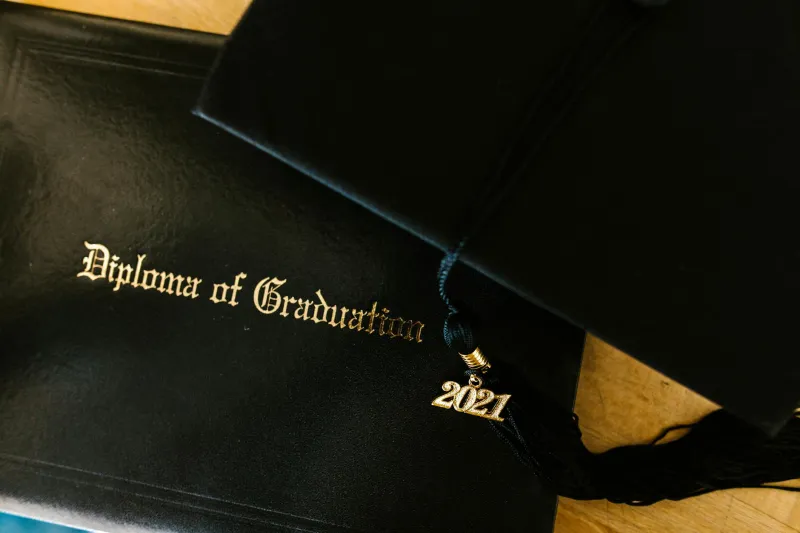
As we continue to debate the value and cost of higher education, it's worth remembering that there was once a time when walking across a graduation stage in cap and gown was enough to walk into the American Dream. The question isn't whether we can return to that exact system, but whether we can recapture its essential promise: that hard work and basic education should be enough to build a middle-class life.