When America Woke Up to Yesterday's World: The Lost Rhythm of Once-a-Day News
The Morning Ritual That Defined Reality
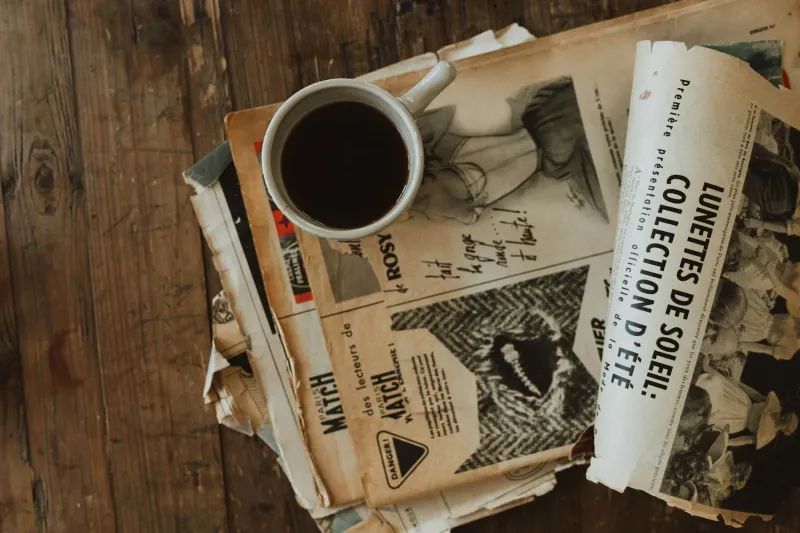
Every morning at 6:47 AM, the Springfield Daily Herald landed with a satisfying thud on doorsteps across town. Inside those folded pages lay everything Americans needed to know about their world: what happened yesterday, what might happen today, and enough context to make sense of both. By 7:30, over coffee and toast, families would absorb their daily dose of reality—measured, edited, and delivered on a schedule that respected the natural rhythm of human attention.
 Photo: Springfield Daily Herald, via springfieldherald.news
That thud is gone now, replaced by the incessant ping of breaking news alerts that turn every moment into a potential emergency.
When News Had Office Hours
In the era of once-a-day news, information operated on human time. Reporters had hours to verify facts, editors had time to provide context, and readers had the luxury of processing events at their own pace. A story that broke at 2 PM wouldn't reach most Americans until the next morning, and somehow, the world kept spinning.
This wasn't a bug in the system—it was a feature. The delay between event and consumption created space for reflection, verification, and perspective. News was something you encountered deliberately, not something that ambushed you while you were trying to focus on work, family, or sleep.
Compare this to today, when breaking news alerts can interrupt your dinner, your meeting, or your child's bedtime story. We've gained immediacy but lost something harder to quantify: the ability to exist in the present moment without constantly monitoring the global temperature.
The Editor as Gatekeeper
When news came once a day, someone had to decide what made the cut. The Springfield Daily Herald had finite space—maybe 32 pages on a good day—which meant every story had to earn its place. Editors acted as filters, deciding which of the day's events deserved public attention and how much context each story needed.
This gatekeeping function, now largely eliminated by infinite digital space, served an important purpose: it created a shared baseline of what constituted "news." Whether you agreed with the editor's choices or not, you and your neighbors were starting each day with roughly the same information set.
Today, we each curate our own reality through social media feeds, news apps, and algorithmic recommendations. We've gained personalization but lost the common ground that comes from shared information experiences. Your breaking news might be completely different from your neighbor's, creating parallel universes of urgency and concern.
The Luxury of Not Knowing Everything Immediately
Perhaps most remarkably, Americans of the once-a-day news era were comfortable not knowing things right away. If a story broke at 3 PM, they accepted that they'd learn about it the next morning. This wasn't ignorance—it was a different relationship with information, one that prioritized depth over speed and reflection over reaction.
This acceptance of delay created psychological space that's almost impossible to imagine today. People could focus on their immediate environment—their work, their families, their communities—without the constant pull of distant events demanding immediate emotional investment.
When Context Came Standard
Daily newspapers didn't just report what happened; they explained why it mattered. With 12-18 hours between event and publication, reporters had time to interview multiple sources, check facts, and provide the background necessary for understanding. Readers received not just information, but interpretation.
Today's breaking news cycle prioritizes speed over understanding. The first alert tells you something happened. The second alert corrects the first. The third adds context. By the fourth, you've either stopped paying attention or you're emotionally invested in a story you still don't fully understand.
This fragmentation of information delivery has trained us to react before we understand, to form opinions based on headlines, and to mistake the volume of information for the quality of our knowledge.
The Evening News as Shared Experience
In the once-a-day era, news consumption was a communal activity. Families gathered around the dinner table with the morning paper or around the television for the evening news. These shared moments created opportunities for discussion, debate, and the kind of slow processing that leads to genuine understanding.
The atomization of news consumption—everyone scrolling their own feeds, receiving their own alerts, consuming their own curated reality—has eliminated these natural opportunities for collective sense-making. We're more informed than ever but less capable of making sense of what we know.
The Hidden Cost of Constant Awareness
The shift from once-a-day news to constant updates promised to make us better informed citizens. In some ways, it delivered: we know about events as they unfold, we have access to multiple perspectives, and we can fact-check claims in real time.
But we've also created a state of permanent alertness that our brains weren't designed to handle. The psychological toll of constant news monitoring—the anxiety, the outrage fatigue, the inability to focus on local and immediate concerns—represents a hidden cost of our hyper-connected information environment.
What We Gained and What We Lost
Today's news environment offers undeniable advantages: speed, variety, global reach, and the ability to follow developing stories in real time. We can access multiple sources, hear from eyewitnesses directly, and participate in conversations about events as they unfold.
But we've traded away something valuable: the rhythm of daily information consumption that respected human attention spans and the need for mental space. We've exchanged the luxury of not knowing everything immediately for the burden of knowing too much, too fast, with too little context.
The next time your phone buzzes with a breaking news alert, remember the satisfying thud of the morning paper on the doorstep. Sometimes the most radical thing you can do is wait until tomorrow to find out what happened today.