The Cathedral of Community Knowledge
Walk into any American library in 1985, and you'd find something that no longer exists: the epicenter of a community's intellectual and cultural life. Teenagers clustered around listening stations, spinning through vinyl records they couldn't afford to buy. College students hunched over microfilm readers, scrolling through newspaper archives for research papers. Families attended weekend lectures on everything from local history to stargazing. The library wasn't just where books lived—it was where communities came to think together.
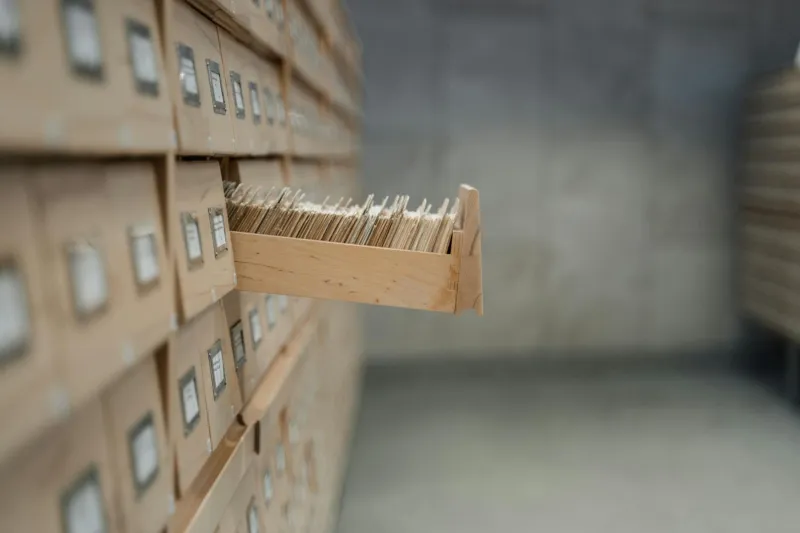
The card catalog, that imposing wooden fortress of tiny drawers, represented something profound: a democratically curated collection of human knowledge, accessible to anyone with a library card. Librarians weren't just book-filers—they were knowledge navigators, research consultants, and cultural programmers rolled into one.
The Research Ritual That Required Patience
Before search engines, research was a physical journey. Finding information about the Civil War meant pulling multiple books from the history section, checking the card catalog for related subjects, and maybe requesting materials from other libraries through interlibrary loan—a process that could take weeks. Students learned to plan ahead, to follow paper trails through footnotes and bibliographies, to synthesize information from multiple sources because finding any information required genuine effort.
The reference section was its own universe: massive encyclopedias, specialized dictionaries, atlases that required two people to lift. The reference librarian was part detective, part teacher, helping patrons navigate these resources to find answers to questions that couldn't be solved with a quick Google search because Google didn't exist.
The Listening Posts That Introduced America to Music
Many Americans discovered their musical tastes at library listening stations. Libraries maintained extensive collections of vinyl records, later cassettes and CDs, that patrons could check out or preview on-site. This was where suburban teenagers first heard jazz, where classical music newcomers could explore symphonies without buying expensive albums, where world music found audiences beyond immigrant communities.
The library's music collection was curated by librarians who balanced popular demand with educational value, exposing communities to genres and artists they might never have encountered otherwise. Before Spotify's algorithm-driven recommendations, human librarians were the original music discovery engine.
The Microfilm Time Machine
Long before digital archives, libraries preserved history on microfilm—tiny photographs of newspapers, magazines, and documents that required special readers to view. Researching historical events meant threading film reels, adjusting focus, and scrolling through page after page of archived material. It was tedious, but it was also treasure hunting.
High school students writing papers about World War II could read actual newspaper accounts from D-Day, complete with period advertisements and local weather reports. This immersive experience connected researchers to historical moments in ways that clicking through digital archives somehow can't replicate.
The Community Living Room
Libraries served as informal community centers in ways that go beyond their official programming. They were warm, quiet spaces where people could spend entire days without spending money. Homeless individuals found respite, elderly residents socialized over newspapers, and parents brought children for story time that was as much about community building as literacy.
Evening lectures drew diverse audiences to hear local authors, visiting scholars, and community experts share knowledge. These events created intellectual communities around shared curiosity rather than shared demographics or income levels. The library was one of the few remaining spaces where Americans from different backgrounds gathered around ideas rather than consumption.
The Digital Earthquake
The internet didn't gradually change libraries—it fundamentally questioned their existence. Why visit a building to access information when everything was becoming available online? Why browse physical music collections when digital streaming offered infinite catalogs? Why attend lectures when YouTube provided unlimited educational content?
Libraries fought back by reinventing themselves as technology centers, offering computer access, digital literacy training, and maker spaces with 3D printers. They expanded programming to include job training, tax preparation, and social services. But something essential was lost in the translation: the library's role as the community's primary knowledge hub.
What the Internet Couldn't Replace
Google can answer questions instantly, but it can't replicate the serendipitous discovery that happened when browsing physical shelves led to unexpected finds. Spotify offers personalized playlists, but it can't recreate the experience of a librarian recommending an album based on knowing your musical journey. Wikipedia provides vast information, but it lacks the curated quality and local relevance that made library collections valuable.
Most importantly, digital platforms are designed for individual consumption, while libraries were designed for community learning. The quiet collaboration that happened when strangers shared research tables, the intergenerational knowledge transfer that occurred during library programs, and the democratic access to expensive resources—these social functions of libraries proved harder to digitize.
The Librarian as Curator vs. the Algorithm as Gatekeeper
Librarians were human filters who balanced community needs with intellectual diversity, popular demand with educational value. They made decisions about collection development based on local interests, academic requirements, and cultural gaps they observed in their communities. This human curation created collections that reflected both universal knowledge and local character.
Algorithms optimize for engagement and profit, not education or community building. They create filter bubbles that reinforce existing interests rather than expanding them. The loss of human curation means we've gained infinite access to information but lost thoughtful guidance about what's worth knowing.
The Quiet Persistence of Physical Knowledge
Despite predictions of their obsolescence, libraries persist, though their role has fundamentally changed. They've become safety nets for digital divides, homework centers for students without home internet, and community anchors for neighborhoods losing other gathering spaces. But they're no longer the intellectual and cultural centers they once were.
The COVID-19 pandemic revealed both libraries' continued importance and their vulnerability. When buildings closed, libraries pivoted to digital services, but the community functions that made them special—the serendipitous encounters, the shared quiet spaces, the human guidance—couldn't be replicated through Zoom programs and curbside pickup.
The Democracy of Shared Knowledge
The traditional library represented something uniquely American: the idea that knowledge should be freely accessible to everyone, regardless of economic status. This wasn't just about books—it was about creating informed citizens capable of participating in democratic society. The librarian's oath to serve all patrons equally embodied democratic ideals in daily practice.
Today's information landscape, dominated by subscription services, paywalls, and algorithmic filtering, has made knowledge access more dependent on economic resources and technical literacy. We've gained convenience and selection, but we've lost the democratic guarantee that all citizens could access the same high-quality information resources.
The library's transformation from community knowledge center to digital support service reflects broader changes in how Americans relate to information, community, and each other. We've become more connected globally but less connected locally, more informed about distant events but less knowledgeable about our immediate communities, more capable of finding quick answers but less practiced at deep research and sustained thinking.
The question isn't whether libraries should return to their former role—that's impossible in our digital age. The question is whether we can create new institutions that combine digital efficiency with the democratic access, human curation, and community building that made libraries essential to American civic life.