The Original Feed Was a Conversation
Every American neighborhood had its unofficial nerve center, and it wasn't the town hall or the newspaper office. It was Joe's Barbershop, or Mike's, or whatever name hung above the red, white, and blue pole spinning outside a storefront where men gathered not just for haircuts, but for democracy in action.
For decades, the barbershop functioned as something no algorithm has ever managed to replicate: a genuine community forum where information flowed freely, opinions were tested against real neighbors, and the pulse of local life could be taken simply by listening to the conversations bouncing between the chairs.
The $1.50 Seat in America's Ongoing Debate
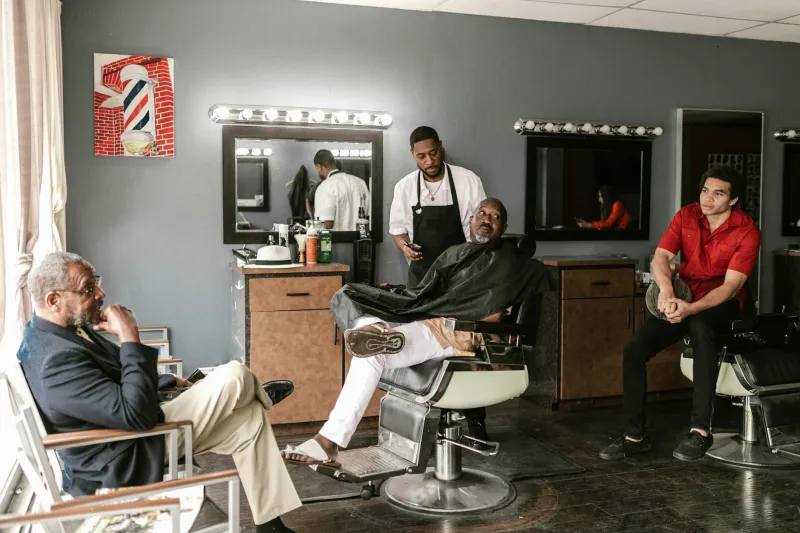
Walk into any barbershop between 1950 and 1980, and you'd find the same scene playing out across the country. Four or five chairs lined up against mirrors, each one occupied by a customer getting more than just a trim. The barber—part craftsman, part therapist, part moderator—would guide conversations that ranged from last night's game to next month's mayoral election.
The waiting area told its own story. Folding chairs arranged in a loose circle, occupied by men reading newspapers that would be passed around, discussed, argued over, and thoroughly dissected before anyone left. Sports Illustrated and Popular Mechanics sat next to local papers, but the real content was generated live, in real time, by people who actually knew each other.
Where Local Politics Got Personal
The barbershop was where abstract political concepts became concrete neighborhood concerns. City council decisions weren't distant bureaucratic moves—they were topics that directly affected the guy getting his sideburns cleaned up. "That new traffic light they're putting in is gonna mess up my morning commute," someone would say, and suddenly half the shop was debating traffic patterns, city budgets, and whether Councilman Peterson was looking out for working families.
These weren't echo chambers. The barbershop drew from across economic lines—the bank president might be sitting next to the factory worker, both waiting their turn and both expected to defend their positions if they spoke up. Disagreements were common, but they happened face-to-face, between people who would see each other again next month.
The Information Network That Never Needed WiFi
News traveled through the barbershop faster than through any other medium. Someone would mention that the Kowalski family was moving, and within minutes the entire shop would know why, where they were going, and what it meant for the neighborhood softball team. A factory layoff announcement would be analyzed from every angle—economic impact, political implications, and practical effects on families everyone knew personally.
The barber himself often served as the hub of this information network. Cutting hair eight hours a day, six days a week, he heard everything first and developed an encyclopedic knowledge of local happenings. Customers would ask him about job openings, housing situations, and community events, treating him as a combination news anchor and advice columnist.
The Ritual That Built Community
Getting a haircut was never just about hair maintenance. It was a monthly or bi-weekly ritual that maintained social connections. Regular customers had their preferred barbers, their usual appointment times, and their established roles in the ongoing conversation. The shy guy who mostly listened, the loudmouth who dominated every topic, the wise elder whose opinions carried extra weight—everyone had their place in the barbershop ecosystem.
This regularity created something that modern social media promises but rarely delivers: genuine community engagement. People weren't performing for an invisible audience or crafting their image for maximum likes. They were simply being neighbors, sharing opinions and information with people they'd continue to encounter in real life.
Today's $45 Silence
Walk into a modern barbershop or salon, and the scene has fundamentally changed. Customers sit in chairs staring at their phones, scrolling through feeds that promise to keep them informed and connected. The conversation that once filled these spaces has been replaced by the soft buzz of individual entertainment consumption.
When discussion does occur, it's often between customer and barber only—a private conversation rather than a community dialogue. The waiting area features individual chairs facing a television, discouraging the kind of circle-style discussion that once characterized these spaces. Many shops have abandoned the communal waiting experience entirely, operating by appointment only and eliminating the spontaneous mixing that made barbershops special.
What Algorithms Can't Replicate
Modern social media promises to connect us with our communities, but it can't reproduce what the barbershop provided: immediate, face-to-face accountability for our opinions. Online, we can share articles without reading them, express outrage without consequences, and engage in debates with strangers we'll never encounter again.
The barbershop demanded something different. If you expressed a strong political opinion, you might find yourself defending it to your neighbor, your kid's Little League coach, and the guy who fixed your car last month. This created a natural check against extreme positions and encouraged more thoughtful engagement with local issues.
The Democracy We Styled Away
The decline of the barbershop as community center represents more than a shift in grooming habits—it's the loss of a democratic institution that taught Americans how to disagree productively, stay informed about local issues, and maintain social connections across economic and generational lines.
We've replaced the barbershop's messy, imperfect, but genuinely human version of community engagement with the clean efficiency of digital interaction. We can now access more information, connect with more people, and express our opinions to larger audiences than ever before.
But we've lost the art of democracy that happened one conversation at a time, in a place where your neighbors knew your name and your opinions had to stand up to face-to-face scrutiny. The barbershop was America's original social network, and no app has managed to cut it quite the same way.